
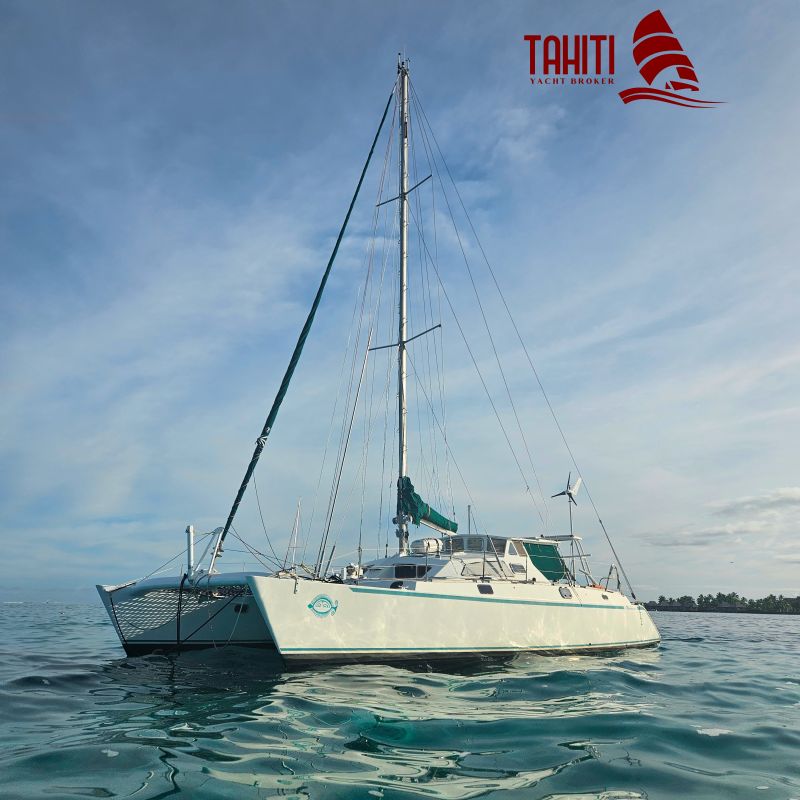
Simpson 44 (13.20 m) – 2002
Price reduction: 14.2 M XPF / 119,000 € 11.2 M XPF / 99,000 €
The Simpson 44 is a 13.20-meter catamaran designed by Australian architect Roger Simpson. Launched in 2002, this model has a solid reputation for seaworthiness, demonstrated by the reliability of its hulls in difficult weather conditions. The vessel is under French flag and registered in Papeete, available immediately in French Polynesia.
Construction and Structure
The boat is built in composite (marine plywood and epoxy resin) with integral bi-axial fiberglass lamination. In 2007, a complete refit was carried out, including the addition of aft skirts, reinforcement of the keels and chainplates, and the creation of buoyancy compartments, making the structure more rigid and secure. The last antifouling was done in March 2024.
Interior Layout
The deck plan and hulls are organized for the autonomy and comfort of 8 people:
-
4 double cabins distributed in both hulls.
-
2 heads with showers and 3 electric toilets.
-
Nacelle: A spacious L-shaped saloon and a chart table.
-
Galley: Equipped with a stainless steel stove, a 70 L refrigerator, and a high-performance 80 L freezer.
Engine and Power
Propulsion is provided by two Yanmar 30 HP engines (2000 h), maintained with new stuffing boxes (2024). Autonomy is a strong point with a modular fuel capacity of up to 600 L and a 100 L/h watermaker. The electrical system includes:
-
850 W of solar panels and a Superwind wind generator.
-
AGM battery bank of 440 Ah (2022).
-
Victron inverters: 400 W and 2000 W.
Rigging and Equipment
Rigged as a sloop with a removable forestay and Dyneema backstay, the sailboat has a set of sails in good condition protected by effective UV treatment. The electronics include a B&G hydraulic autopilot, a Furuno AIS transponder, and a Calypso Bluetooth anemometer. The inventory is completed by a rigged rigid dinghy (sail and 4 HP engine), a kayak, and a large stock of spare parts and tools.
This simple and robust catamaran is configured for immediate use, whether for a family project or charter activity.
General Specifications:
- Length: 13.20 m (43′ 3″)
- LOA: 13.50 m
- Beam: 7 m
- Draft: 1.25 m
- Gross tonnage: 10.45 T
- Construction material: Composite
- Rigging: Sloop
- Engine: 2 Yanmar 3YM30 – 30 HP
French flag. Registered in Papeete.
Accommodations:
8 berths – 4 double cabins
Port Hull
- Forward head with shower and toilet
- Forward double cabin
- Galley
- Aft double cabin
Starboard Hull
- Forward head with shower and toilet
- Forward double cabin
- Workshop
- Aft double cabin
Nacelle
- Large L-shaped saloon
- Chart table to port
Detailed Inventory:
Construction
Composite catamaran, Simpson 44 type, built in 1992, launched in 2002, by renowned Australian architect and builder Roger Simpson. Refitted in 2007.
Built in marine plywood, double layers below the waterline for a shaped hull, covered with bi-axial glass fabric and epoxy resin. The hull was built in Australia by a shipyard, then partially finished over a long period (10 years) but never launched; first launch in 2002.
Rigged as a sloop, with a headsail at the masthead and a removable forestay.
This type of catamaran is famous in Australia because one of them survived uncrewed the very famous “Queen’s Birthday Storm”.
In 2007, a total refit of the catamaran: layout, propulsion, electricity, and complete renovation:
– Addition of large aft skirts in fiberglass and epoxy resin.
– Epoxy resin and fiberglass lamination of the deck, cockpit, and all underwater parts (hull sections), nacelle (interior and exterior), and inside the hulls up to the waterline.
– Reinforced keels with unidirectional glass fabric.
– Structural reinforcement with cabin floors forming buoyancy reserves and acting as a double hull in case of damage; the galley and workshop floors can serve as diesel tanks.
– Reinforcement of structures at the chainplate level.
All these works greatly stiffened and reinforced the hull structure, of course at the cost of some additional weight.
The current owner is selling it because he is returning to mainland France.
Engine
- 2 Yanmar 3YM30 diesel engines, 30 HP each (2000 h, 2007)
- Speed at 2500 RPM: 5 knots on one engine, 7 knots on two engines
- Fuel consumption: 2.5 L/h per engine
- Volvo stuffing boxes (new in 2024)
- Bronze three-blade propellers
- Diesel tanks: 100 L per engine, expandable to 300 L (100 + 200 L) if the built-in tanks in the hulls (serving as floors for the galley and workshop) are filled
- Total possible: 600 L, allowing great autonomy when using only one engine
Sloop Rigging
- Aluminum mast with 2 spreader levels and steps
- Stainless steel standing rigging, 10 mm single-strand, 12 mm forestay, Dyneema backstay with block and winch for easy removal, ensuring strong rigging
- Headsail at the masthead, backstay
- Removable textile forestay to hoist a storm jib instead of the roller-furling genoa in case of strong winds or genoa issues
- Aluminum boom with reefing points, one winch on the deck near the mast
- 4 m mainsail track aft of the cockpit, ensuring easy and effective mainsail control
- Oversized BARIENT winches (Australia) for jib and mainsail sheets
- Oversized LEWMAR winches on the mast
- Mainsail and genoa in perfect condition (seams covered with acrylic paint for very effective UV protection), new genoa sheets (2024)
- 2 spinnakers in average condition
- 6 m aluminum spinnaker pole with bell on the mast
Anchoring
- LOFRANS 1500 W windlass
- Primary anchor: ROCNA 25 kg (2024) + 70 m of 10 mm galvanized chain (new)
- Secondary anchor: ROCNA 18 kg
Comfort
- 2 freshwater tanks in polypropylene, 200 L each, located at the base of the mast, total 400 L
- 100 L/h watermaker, connected to the starboard engine
- Stainless steel 2-burner stove + oven
- Double sink
- Numerous storage lockers and shelves
- 70 L refrigerator with freezer compartment
- ICEER 80 L freezer, highly efficient due to 10 cm vacuum-insulated walls
- Showers in both forward heads in the hulls
- 3 electric toilets
- Shower in the port aft skirt
- Shower in the cockpit
- Gas barbecue at the stern, with a camping gas bottle in the cockpit locker, featuring a refill system from a 13 kg butane bottle
Electricity
- AGM service battery bank, total 440 Ah (new in December 2022)
- AGM engine battery, 120 Ah
- Portable 1200 W gasoline generator
- 2 Victron inverters (12 V / 220 V): 400 W + 2000 W
- All lighting is LED
- 5 fans (1 per cabin + 1 in the saloon)
- Solar panels on the hardtop roof and aft arch, total 850 W
- Victron MPPT controller
- SUPERWIND wind generator, providing additional power when the wind exceeds 8-10 knots; at sea, it typically powers the autopilot
Electronics and Navigation Instruments
- Hydraulic wheel steering
- B&G hydraulic autopilot (OCTOPUS pump) with 2 control units, 2 compasses, 2 rudder angle sensors, 2 repeaters
- SIMRAD backup autopilot on the tiller
- Horizon Marine VHF
- FURUNO AIS transponder (transmitter, receiver)
- 1 CALYPSO Bluetooth anemometer at the masthead, app for Android or Apple phones (provides apparent/true wind angle, wind speed, boat heading, and speed; very precise)
- 1 RAYTHON anemometer inside (at the chart table), mounted at the masthead
Safety
- 8-person liferaft
- 15 adult life jackets and 2 children’s
- KANNAD Safelink Solo EPIRB
Dinghy
- 3.20 m rigid dinghy in plywood + fiberglass + epoxy resin, fully rigged: sail, mast, rudder, centerboard
- Yamaha 2-stroke 4 HP engine (very good condition, 2019)
Miscellaneous
- Lazy bag on the boom
- All canvas work (lazy bag, trampolines, cockpit protections) was done onboard using a SAILRITE machine with TENARA thread, highly resistant to UV (lasts 8-10 years in tropical sun)
- UV protection strip on the genoa (dark green)
- Webbing trampolines
- Trampoline tent (sand color) for shaded naps and wind protection
- Cockpit can be fully enclosed with canvas awnings that lift to form sunshades
- Foldable stainless steel swimming ladder
- Cockpit table with extension
- Gas barbecue
- Aft arch for dinghy and part of the solar panels
- Kauri saloon table
- 3-person inflatable kayak
- 1 heavy-duty fishing rod, PENN ST80 reels
- 1 spare rod
- Extensive fishing gear: lines, hooks, etc.
- Portable 220 V electric tools: drill, sander, angle grinder
- Complete set of wrenches
- Numerous spare parts: engine pumps, alternators, starter, freshwater pump, impellers, O-rings, cylinder head gasket, etc.
Last antifouling: March 2024
Key Strengths
- Simple, sturdy, and safe catamaran.
- Well-equipped and ready to continue its journey.


